Legio V Alaudae
Legio V Alaudae, also known as the Fifth Lark Legion, was founded by Julius Caesar in c. 52 BC from Gallic recruits. Its emblem was the elephant and its gained its cognomen from the distinctive crests the legion wore.
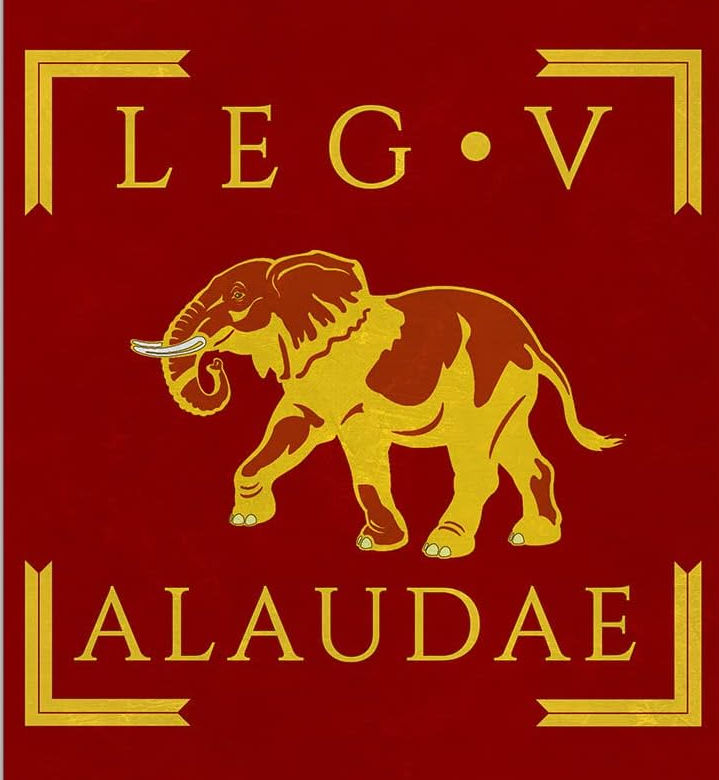
Cognomen: Alaudae
Emblem: Elephant
Major Campaigns: Caesar’s Gallic and Civil Wars (52-45 BC); Mutina (43 BC); Philippi (42 BC); Cantabrian Wars (26-19 BC); Clades Lolliana (16 BC); Drusus’ German Campaigns (12-9 BC); Tiberius’ German Campaigns (10-14 AD); Germanicus’ German Campaigns (15-17 AD); Frisian Revolt (28 AD); Bedriacum (69 AD); Batavian Revolt (69-70 AD)
Main HQ: Vetera (Xanten, Germany)
Early Service
Legio V Alaudae was raised by Julius Caesar to fight in the Gallic Wars using Gallic recruits. The legion then continued to fight for him during his civil war and gained its emblem from fighting enemy elephants at the Battle of Thapsus, 46 BC. It then served under Mark Anthony until it was incorporated into the imperial army after Actium.
The legion was then sent to Hispania to take part in the Cantabrian Wars and on its conclusion, veterans of Legio V Alaudae were settled in the new founded colonies of Hispania.
From there, it was sent to Gaul in 17 BC, where it suffered a humiliating defeat at the hands of the Sugambri and other German raiders, and even lost its eagle. Augustus deemed this defeat important enough for him to travel to Gaul to deal with the problem.
Legio V Alaudae later took part in Drusus’ campaigns of conquest against the Germanic tribes, 12-9 BC.

Service in the 1st c. AD
Legio V Alaudae was part of the army that was preparing for Tiberius’ aborted Marcomannic campaign in 6 AD and held the Rhine frontier during the Varian Disaster of 9 AD. It would have sent at least a vexillation for Tiberius’ punitive campaigns across the Rhine in the following years.
When Augustus died in 14 AD, the legion mutinied along with many other of the Rhine legions. It would have then been taken on Germanicus’ campaigns across the Rhine, as a distraction. Legio V Alaudae was crucial in crushing the Frisian Revolt that broke out in 28 AD and came to the rescue of the Roman auxiliary forces during one particular battle.

In the Year of the Four Emperors, Legio V Alaudae swore allegiance to Vitellius and sent a vexillation with him to Italy, which fought in both battles at Bedriacum. The rest of the legion on the Rhine had to deal with the Batavian Revolt, 69-70 AD, and were besieged at Vetera (Xanten) until they finally surrendered and were slaughtered.
It was originally thought that Legio V Alaudae was disbanded in 70 AD but epigraphical evidence now points to its demise occurring on the Danube, either in Domitian’s Dacian campaign, c. 85-86 AD, or in a campaign against the Sarmatians in 92 AD.
Interactive Map
Embark on a journey through time and space with our interactive map to discover the far-reaching influence of Legio V Alaudae on the Roman Empire.
Confirmed Members
The following table lists members of Legio V Alaudae who have been identified through epigraphical or historical sources.
Please note that the dates listed in the table refer to the inscriptions themselves, not necessarily the exact time period during which the individuals served in the legion.
| Name | Rank | Date | Found | Source |
|---|---|---|---|---|
| Cethegus Labeo | Legate | – | – | Tacitus, Annales, iv.73 |
| Ti. Plautius Silvanus Aelianus | Legate | c. 37-43 AD | Tivoli, Italy | CIL XIV, 3608 |
| Cornelius Aquinus | Legate | – | – | Tacitus, Histories, i.7 |
| Fabius Fabullus | Legate | – | – | Tacitus, Histories, iii.14 |
| C. Aemilius Fraternus | Tribune | 29-17 BC | Tarragona, Spain | CIL II, 4188 |
| A. Egrilus Rufus | Tribune | c. 50-100 AD | Ostia Antica, Italy | AE 1955, 168 |
| Cn. Domitius Tullus | Tribune | 81-96 AD | Foligno, Italy | CIL XI, 5211 |
| Cn. Domitius Lucanus | Tribune | 79-81 AD | Foligno, Italy | CIL XI, 5210 |
| T. Vidius Fortunatus | Legionary | c. 51-100 AD | Trieste, Italy | CIL V, 547 |
| C. Julius Verox | Veteran | 1st c. AD | Morani, North Macedonia | IMS-06, 41 |
| L. Poblicius | Veteran | c. 31-50 AD | Cologne, Germany | AE 1979, 412 |

 Digital Maps of the Ancient World