Tezcatlipoca
Tezcatlipoca, a major deity in the Aztec pantheon, was a figure shrouded in mystery and power. Associated with the night sky, darkness, sorcery, and the Great Bear constellation, he was a complex and multifaceted god.

Residence: Ilhuicatl-Teteocan (Twelfth Heaven), Ilhuicatl-Yayauhco (Sixth Heaven), the North
Parents: Ometecuhtli and Omecihuatl (Codex Zumarraga)
Consort: Quetzalcoatl, Xipe-Totec, Huitzilopochtli (Codex Zumarraga)
Siblings: Xochiquetzal, Huixtocihuatl, Xilonen, Atlatonan
Festivals: Toxcatl
The cult of Tezcatlipoca was introduced to central Mexico by the Toltecs, Nahua-speaking warriors from the north, at the end of the 10th c. AD. His association with the Toltecs is significant, as they were a powerful and influential civilization that played a major role in shaping Mesoamerican culture.
Numerous myths relate how Tezcatlipoca expelled Quetzalcóatl, the Feathered Serpent, from his center at Tula. As a protean wizard, Tezcatlipoca used his black magic to cause the death of many Toltecs and induced Quetzalcóatl to sin, drunkenness, and carnal love, thus putting an end to the Toltec golden age. This event marked a turning point in Mesoamerican history, as it led to the decline of Toltec power and the rise of the Aztecs.

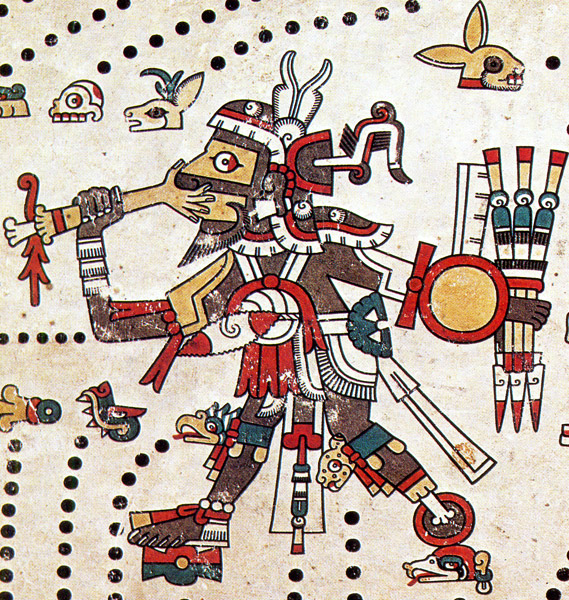
Tezcatlipoca was often represented with a black stripe across his face and an obsidian mirror in place of one of his feet. The obsidian mirror, a symbol of his ability to see everything, reflected his omniscience. He was considered a creator god and ruled over Ocelotonatiuh, the first of the four worlds created and destroyed before the present universe.
The Maya-Quiché people of Guatemala revered Tezcatlipoca as a lightning god under the name Hurakan. This connection highlights the influence of Tezcatlipoca’s cult beyond Aztec territory and demonstrates the interconnectedness of Mesoamerican cultures.
In the Aztec pantheon, Tezcatlipoca was one of the most powerful deities, ruling alongside Huitzilopochtli, Tlaloc, and Quetzalcóatl. He was known by various names, including Yoalli Ehécatl (“Night Wind”), Yaotl (“Warrior”), and Telpochtli (“Young Man”). He was said to appear at crossroads at night to challenge warriors and was the protector of slaves.
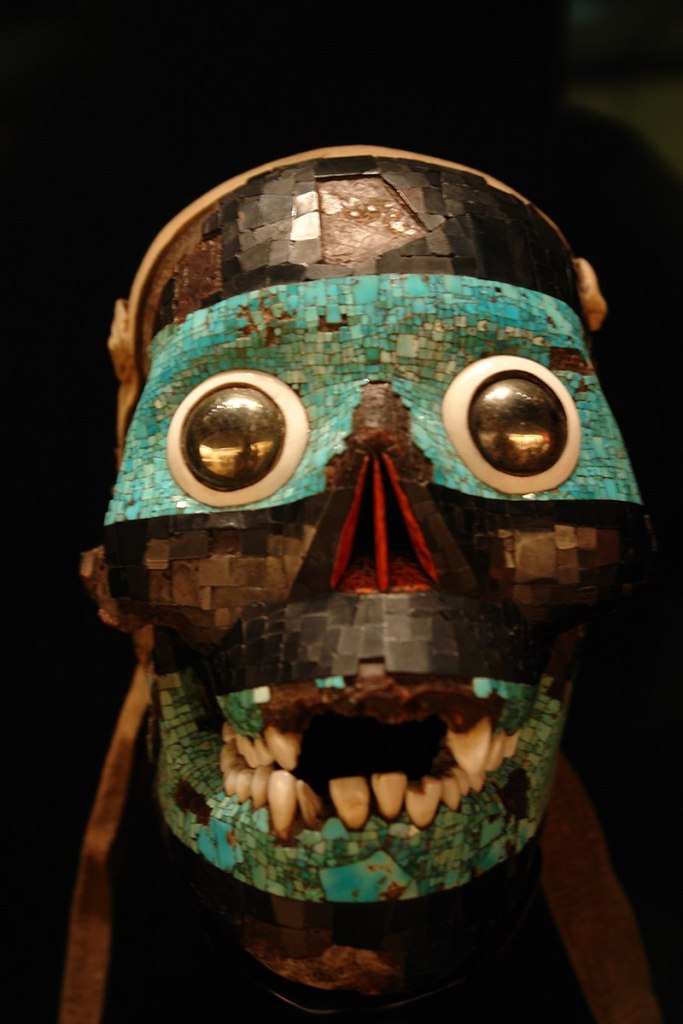
The main rite of Tezcatlipoca’s cult took place during Toxcatl, the fifth ritual month. A young and handsome war prisoner was selected to impersonate the god for a year, accompanied by four beautiful girls dressed as goddesses. On the appointed feast day, he climbed a temple and was sacrificed by the removal of his heart.
Outside of the Aztec capital, Tezcatlipoca was especially revered at Texcoco and in the Mixteca-Puebla region between Oaxaca and Tlaxcala. His influence extended far beyond Tenochtitlán, demonstrating his widespread popularity and importance in Mesoamerican culture.
Art


 Digital Maps of the Ancient World