Nut
Nut embodied the celestial expanse as the goddess of the sky, stars, and cosmos.
She presided over the vastness of the heavens, symbolizing not only the physical sky but also the overarching universe itself. Nut’s divine domain extended beyond the celestial realm to encompass motherhood, representing the nurturing and protective aspect of the maternal figure. In the pantheon, she was also associated with astronomy, reflecting the ancient Egyptians’ fascination with celestial phenomena and their meticulous observation of the stars.

Symbols: Sky, stars, cow
Parents: Shu and Tefnut
Siblings: Geb
Consort: Geb
Children: Osiris, Isis, Set, Nephthys
Greek equivalent: Rhea
Nut, originally revered as the goddess of the nighttime sky, evolved to embody the entire expanse of the heavens, earning her the title of the sky goddess. Her headdress, featuring the hieroglyphic symbol of a pot, not only represented an integral part of her name but also symbolized the womb, emphasizing her role as a maternal figure.
Typically depicted in human form, often nude, Nut occasionally took on other forms in Egyptian iconography. She could appear as a cow, with her immense body forming the overarching sky and heavens, or as a sycamore tree, symbolizing her connection to the earth and the cosmos. Another representation portrayed her as a giant sow nursing numerous piglets, symbolizing the stars scattered across the night sky.
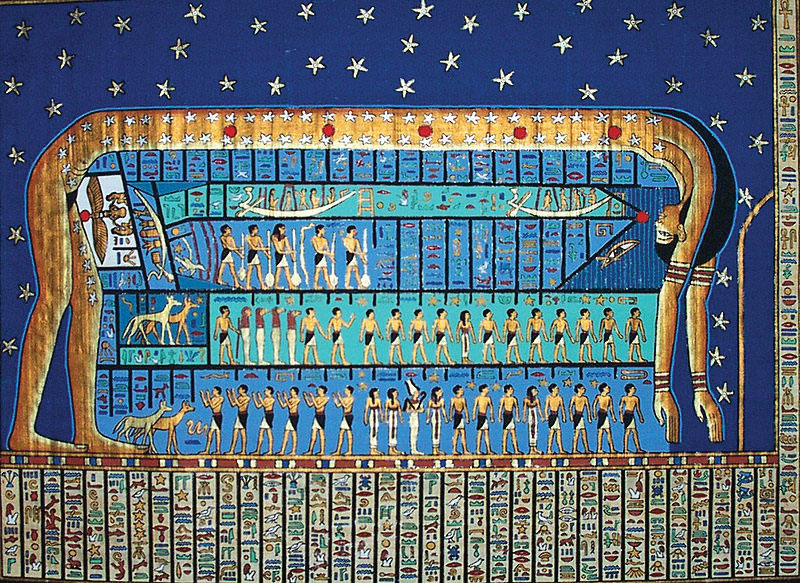
Nut and Ra
Ra was the second ruler of the world, known for his strength and authority, yet he harbored a deep fear of losing his throne. This fear intensified when he learned that Nut, his granddaughter, was destined to bear children who might challenge his reign. Determined to prevent this prophecy, Ra issued a decree, forbidding Nut from giving birth on any day of the year.

Unwilling to accept this fate, Nut sought the aid of Thoth, the god of wisdom and magic. Thoth, sympathetic to her plight, devised a cunning plan to outwit Ra. He engaged Khonsu, the moon god, in a series of wagers, each time winning a portion of Khonsu’s moonlight. With this accumulated moonlight, Thoth created five additional days outside the bounds of the traditional year, enabling Nut to give birth to her children.
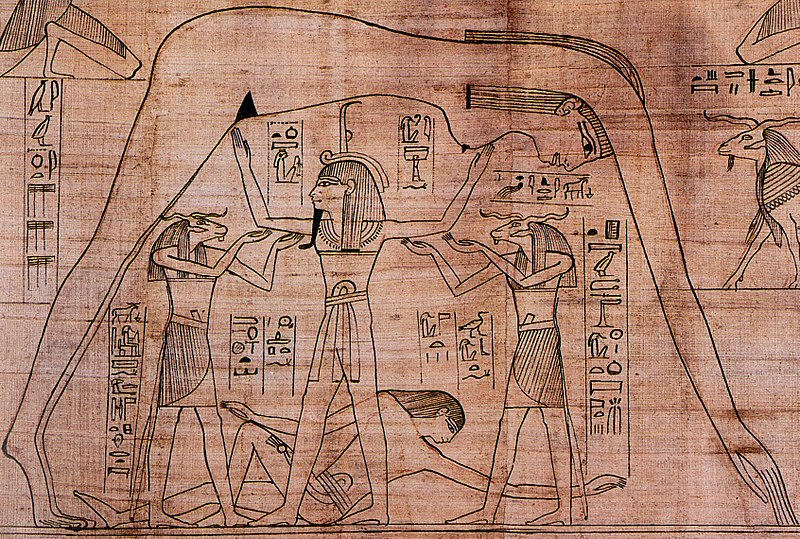
Despite Ra’s furious reaction upon discovering Nut’s actions, she remained resolute, ultimately bearing five children: Osiris, Horus the Elder, Set, Isis, and Nephthys. Ra’s anger led him to separate Nut from her husband Geb, condemning them to eternal separation by entrusting their father Shu to keep them apart. However, Nut, unwavering in her decision, stood by her choice despite the consequences.

 Digital Maps of the Ancient World