Paris
Paris, son of King Priam and Queen Hecuba of Troy, ignited the flames of the Trojan War by sparking a scandal. He took Helen, queen of Sparta, away from her home, a decision that plunged Greece and Troy into a devastating conflict.

Parents: Priam and Hecuba
Consort: Helen
Sibling: Hector, Cassandra, Deiphobus and Helenus
Early Life
Hecuba’s sleep was shattered by a horrifying vision. A blazing torch, birthed from her womb, consumed Troy in an inferno. The prophecy, chillingly interpreted by Aesacus, declared her unborn child would be the city’s doom. Dread coiled around Priam’s heart as the day of Paris’ birth arrived. Aesacus’ grim words echoed – a child born of royalty that day must be sacrificed to save the kingdom. But how could they kill their own flesh and blood? Torn between love and duty, they made a heart-wrenching decision. Paris was entrusted to a herdsman, with the unspoken plea to carry out the prophecy’s grim verdict.

The herdsman, burdened by the weight of their request, found himself unable to harm the innocent babe. He left Paris on Mount Ida, exposed to the elements and the whims of fate. But fate, it seemed, had other plans. A she-bear, emerging from the woods, stumbled upon the abandoned child. Not with fangs and fury, but with a gentle maternal instinct, she nudged him closer, offering him nourishment and a temporary haven. Days later, the herdsman, overcome with guilt and a flicker of hope, returned to find Paris miraculously alive, suckling on the bear’s milk. Unable to abandon him any longer, he took Paris back, raising him amongst the rolling hills and whispering winds. Years passed, and Paris grew into a strong, handsome young man. He found solace and companionship in Oenone, a beautiful nymph who dwelled in the heart of the forest. Little did he know, his idyllic life was about to be swept away by the currents of destiny.
The Judgement of Paris
Eris, the goddess of discord, a figure of chaos wrapped in a mischievous grin, seethed at being excluded from the joyous wedding of Peleus and Thetis. As laughter and music filled the air, she snuck past Hermes, the gatekeeper, and tossed a golden apple into the midst of the celebration. It was a magnificent fruit, polished to a blinding shine, an inscription “To the most beautiful” swirling around its surface like a forbidden promise.

The apple ignited a firestorm. Hera, the queen of gods, her eyes flashing with fury, declared it rightfully hers. Athena, the warrior goddess, bristled, logic and reason warring with sudden insecurity. Aphrodite, the goddess of love, a vision in flowing silks, sent a playful smile in Paris’ direction, who had just been summoned to judge the dispute.
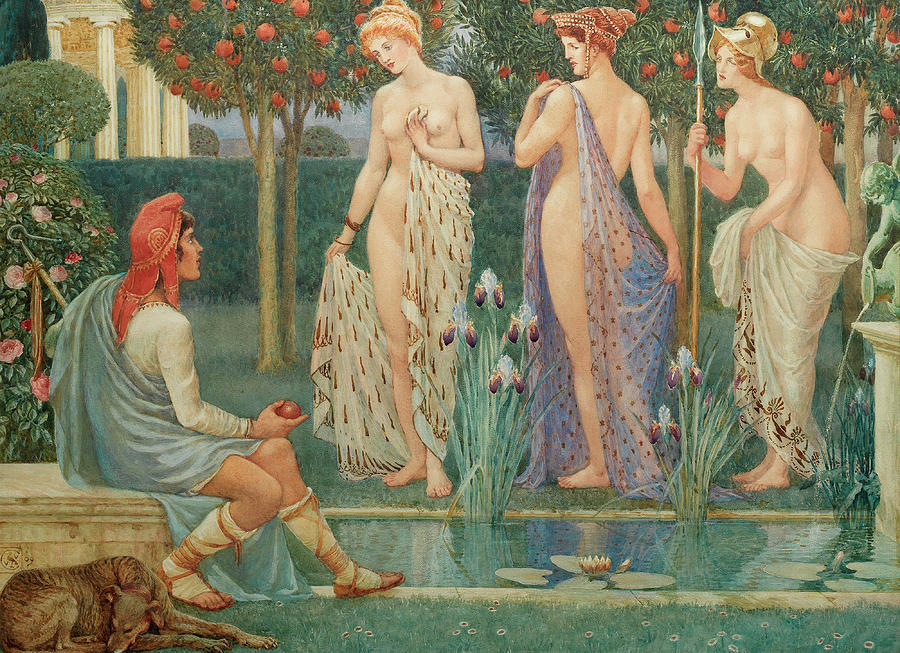
Paris, a young Trojan prince, stood bewildered by the sight before him. The goddesses, abandoning their divine facade, appeared in all their breathtaking beauty. Hera, a vision of power and regality, promised him dominion over vast lands. Athena, her eyes gleaming with the promise of strategy and glory, offered unmatched wisdom and battlefield prowess. But it was Aphrodite’s soft words, a whisper of love and the most beautiful woman in the world as his wife, that swayed his heart. A flicker of unease crossed his face, a fleeting premonition of the storm his choice would unleash. Blinded by the allure of beauty, Paris pledged the apple to Aphrodite, setting in motion a chain of events that would plunge Greece and Troy into a devastating war.

The Trojan War
Paris, though handsome and charming, was never known for his prowess on the battlefield. He preferred the distance and anonymity offered by his bow, a weapon often looked down upon by those who favored close-quarters combat. Despite his shortcomings, fate thrust him into the heart of the conflict. Aided by the god Apollo, it was Paris’ arrow that found its mark – piercing the heel of the mighty Achilles, the Greek champion. This act, while strategically significant, did little to dispel the whispers of cowardice that dogged him.

As the war raged on, Paris himself found himself mortally wounded by Philoctetes, a skilled archer on the Greek side. Desperate, Helen sought out Oenone, the nymph with whom Paris had shared a love before the allure of Helen had swept him away. Oenone possessed a gift – the ability to heal any wound. But her heart, still raw from Paris’ betrayal, remained unmoved. She refused to help, leaving Paris to succumb to his injuries. News of his death reached Oenone, and overcome with a crushing wave of grief and regret, she took her own life, throwing herself upon his funeral pyre.
Helen, once again caught in the maelstrom of war’s consequences, was forced to marry Deiphobus, Paris’ brother. However, Troy’s fate was sealed. The city fell, and Deiphobus met his end at the hands of Menelaus, Helen’s rightful husband. The woman whose beauty had sparked a thousand ships now faced an uncertain future, forever linked to the conflict that had ravaged Greece and Troy.

 Digital Maps of the Ancient World