Mithras
Mithraism, also known as the Mithraic Mysteries, was a fascinating Roman mystery religion that flourished for centuries. This religion centered around the veneration of Mithras, a god of Iranian origin. While inspired by the Zoroastrian divinity of the same name, the Roman Mithras developed distinct characteristics and rituals, separate from his Iranian counterpart.

Mithraism flourished among Roman soldiers, particularly from the 1st-4th c. AD. Its emphasis on courage, discipline, and loyalty resonated deeply with the military way of life.
Mithraism boasted a complex structure, with initiates progressing through seven distinct grades. These grades were marked by initiation rituals that bound participants together, earning them the title “syndexioi,” meaning “united by the handshake.” These rituals likely took place in underground temples called mithraea (singular mithraeum), many of which have survived to this day, offering a glimpse into their practices.

The cult appears to have been centered and flourished in Rome, but its reach extended far beyond the capital. It captivated worshippers across the western half of the empire, with communities established as far south as the provinces of Africa and Numidia, and as far north as Britain.
Tauroctony
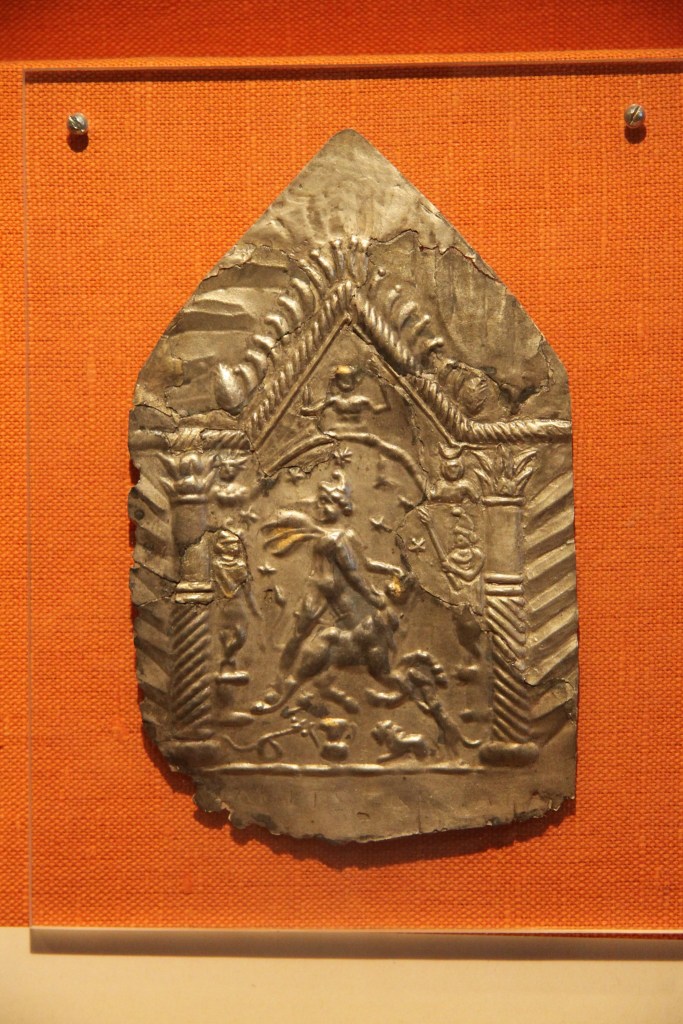
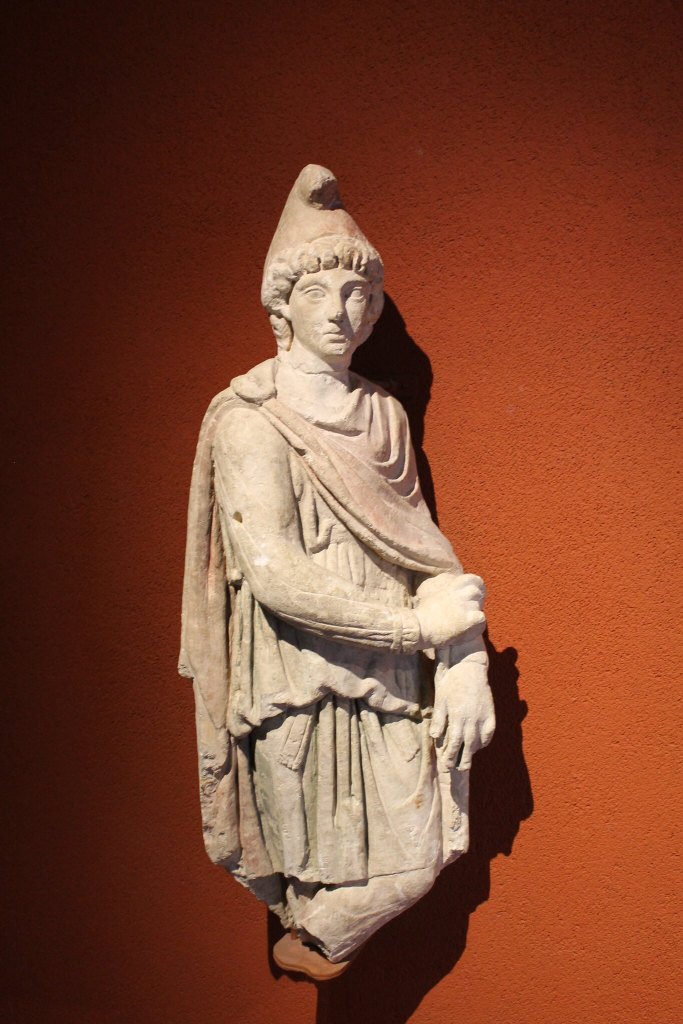
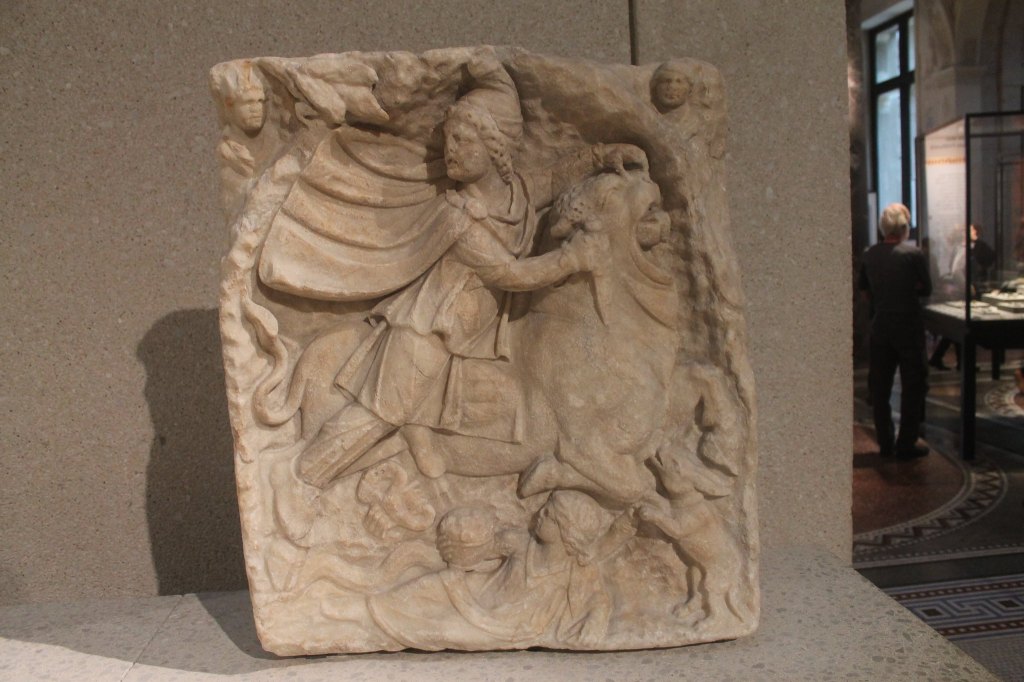
Every Mithraic temple had a central scene known as the tauroctony, depicting the dramatic act of Mithras slaying a sacred bull. Clad in Anatolian garb and a distinctive Phrygian cap, the powerful god Mithras kneels upon the exhausted bull. With one hand, he grips its nostrils, while the other plunges a dagger into its side. His gaze, however, is turned upward, seemingly acknowledging the sun god Sol.

This symbolic tableau is rich with detail. A dog and a snake eagerly lap up the bull’s spilled blood, while a fierce scorpion clamps onto its genitals. A raven, often associated with death and prophecy, circles the scene. From the bull’s tail, remarkably, sprouts a new life – three stalks of wheat.
The bull itself, frequently depicted as white, symbolizes fertility and sacrifice. The unnatural way Mithras sits upon it, with one leg restraining its hoof and the other bent against its back, further emphasizes the subjugation of the wild. Flanking the central scene are two torchbearers, Cautes and Cautopates, mirroring each other’s poses but holding their torches in opposite directions, symbolizing light and dark.
The setting for this dramatic act is a cave, representing the womb of the earth. Here, Mithras is believed to have overpowered the bull after a relentless hunt. The cave is sometimes encircled by the zodiac, signifying the cyclical nature of life and death.

Beyond the cave entrance, bathed in the light of Sol Invictus, the invincible sun god, Sol, drives his flaming chariot. A ray of light often connects him to Mithras, highlighting their connection. On the opposite side, Luna, the moon goddess, guides her two-bull chariot, adding a celestial touch to the scene.
In some depictions, elaborate friezes along the sides depicted Mithras’ miraculous birth, his struggle with the bull, the pact with the sun god Sol Invictus, and his ultimate ascension to the heavens, adding a narrative layer to this captivating central image..
The Mithraeum
Unlike grand temples above ground, Mithraea were distinctive for being entirely subterranean – windowless chambers built into the earth. In cities, they might be cleverly tucked into the basements of buildings, while elsewhere they were either carved from existing caves or constructed with vaulted ceilings, sometimes using economical materials like lath and plaster.

These hidden sanctuaries, typically small and unassuming from the outside, prioritized creating new spaces rather than modifying existing ones. Their location often held significance, situated near springs or streams as fresh water seems to have played a crucial role in Mithraic rituals. A basin incorporated into the structure likely served this purpose.
The Seven Grades of Mithraism
Mithraism boasted a complex system with seven distinct grades of initiation. These grades weren’t just titles; they represented a spiritual journey towards enlightenment and a connection with the divine, particularly Mithras himself. Here’s a brief overview of each grade:
- Corax (Raven): This was the entry-level grade, symbolizing curiosity and the beginning of the Mithraic path.
- Nymphus (Bridegroom): This grade possibly involved ritualistic tests or challenges, and may have alluded to a symbolic marriage with Mithraism itself.
- Miles (Soldier): Here, the focus shifted to discipline, courage, and loyalty – virtues highly valued by Mithras and his followers, especially Roman soldiers.
- Leo (Lion): Strength and bravery were emphasized in this grade, potentially linked to the lion’s association with solar power and kingship.
- Perses (Persian): This grade might have connected initiates to the origins of Mithraism, which drew inspiration from Iranian deities.
- Heliodromus (Sun Runner): Symbolizing closeness to the divine, this grade likely indicated a deeper understanding of Mithraic mysteries and a connection to the sun god Sol Invictus.
- Pater (Father): The highest grade, Pater represented spiritual leadership and potentially acted as a guide for new initiates.
The specifics of rituals and teachings associated with each grade are still debated by scholars. However, the overall structure functioned as a ladder of ascension, with initiates gradually gaining knowledge and spiritual connection as they progressed through the Mithraic mysteries.
Art


Saalburg Museum.

Museum of Aquitaine.


 Digital Maps of the Ancient World