Coriolanus
Coriolanus’ story is a complex one. He was a celebrated war hero but also a man of immense pride and arrogance. This ultimately led to his exile from Rome and his decision to lead the Volscian forces against his own city.

Siege of Corioli
Amidst the chaos of the siege of Corioli, Gnaeus Marcius stood watch. When a fresh wave of Volscian attackers emerged from Antium, he saw his chance. With fearless determination, he rallied a small band of soldiers and charged at the enemy. They broke through the Volscian lines, and Marcius, fueled by relentless courage, cut a bloody swathe through the surprised Volscian forces.
He pressed his advantage, charging through the gates of Corioli itself. Flames erupted in his wake as he set fire to houses bordering the town wall. The citizens of Corioli cried out in terror, and the entire Volscian force, dispirited by this unexpected assault, crumbled. The Romans emerged victorious, and Corioli fell. For his extraordinary heroism, Gnaeus Marcius was awarded the cognomen Coriolanus.
Conflict and Exile
Triumph turned to turmoil two years after Coriolanus’ victory at Corioli. A grain shortage gripped Rome, and tensions flared as the Senate debated how to distribute imported grain from Sicily. Coriolanus, ever the aristocrat, proposed a controversial solution: tie food distribution to the rollback of recent political reforms that empowered the plebeians.
This enraged the populace. The tribunes, representatives of the plebeians, saw his proposal as an attack on their rights and called for Coriolanus to stand trial. The Senate, caught in the middle, advocated for leniency, perhaps hoping for a compromise. However, Coriolanus, his pride inflamed, refused to appear before the court. This defiance sealed his fate; he was convicted in absentia.
Defection to the Volsci
Burning with resentment towards Rome, Coriolanus sought refuge with the Volsci, his former enemies. There, he found a willing ally in Aufidius, a Volscian leader who shared his animosity towards Rome. Coriolanus, at the head of the Volscian army, swept through Roman territories, reclaiming former Volscian towns and seizing strategic locations like Lavinium and Pedum.
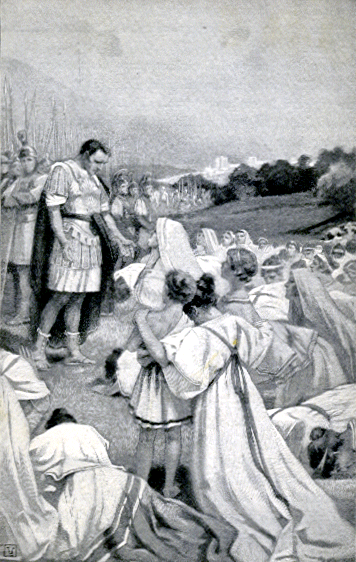
As the siege of Rome dragged on, panic began to set in amongst the Roman populace. The consuls, struggling to hold the city’s defenses, were forced to turn to the Senate for a solution. Desperate pleas for peace fell on deaf ears. Ambassadors, then priests, all returned from Coriolanus’ camp with his unwavering refusal. Finally, a delegation unlike any other approached the Volscian lines – Veturia, Coriolanus’ own mother, accompanied by his wife, Volumnia, their children, and a throng of Roman women. Their tears and entreaties, a potent display of familial duty and love for Rome, pierced Coriolanus’ hardened heart.
Torn between vengeance and his familial bonds, Coriolanus ultimately relented. He ordered the Volscian army to withdraw from Rome. However, his actions had consequences – the Volscians, enraged by his perceived betrayal, drove him into exile once more. His fate after this remains shrouded in mystery.”

 Digital Maps of the Ancient World