Oceanus
Unlike the rivers that flowed through mortal lands, Oceanus wasn’t a physical waterway. This Titan personified the mythical river Oceanus, a colossal stream believed to encircle the entire world. From its depths, according to ancient myths, flowed all the earth’s fresh water. This unseen river, a symbol of the vast unknown, served as a reminder of the mysteries that lay beyond the known world.

Residence: River Oceanus
Parents: Uranus and Gaia
Siblings: Coeus, Crius, Cronus, Cyclops, Furies, Giants, Hecatoncheires, Hyperion, Iapetus, Meliae, Mnemosyne, Phoebe, Rhea, Tethys, Theia and Themis
Consort: Tethys
Children: The Oceanids and the Potamoi
Unlike many of his Titan kin, Oceanus wasn’t driven by violence. He refused to participate in the castration of their father, Uranus, a rebellion steeped in vengeance. Furthermore, he remained neutral during the war between the Titans and the Olympian gods led by Zeus. This pacifistic nature set him apart, making him a more enigmatic and potentially sympathetic figure in the grand narrative of Greek mythology.

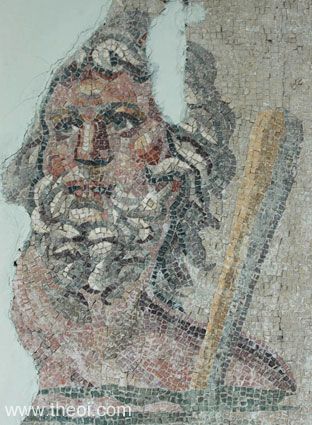
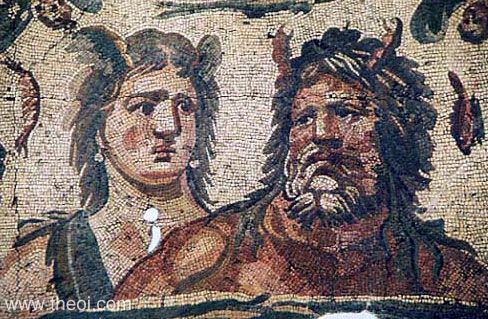
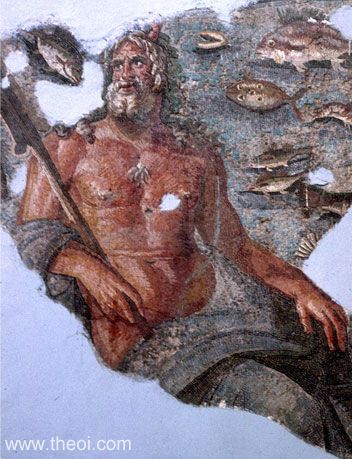
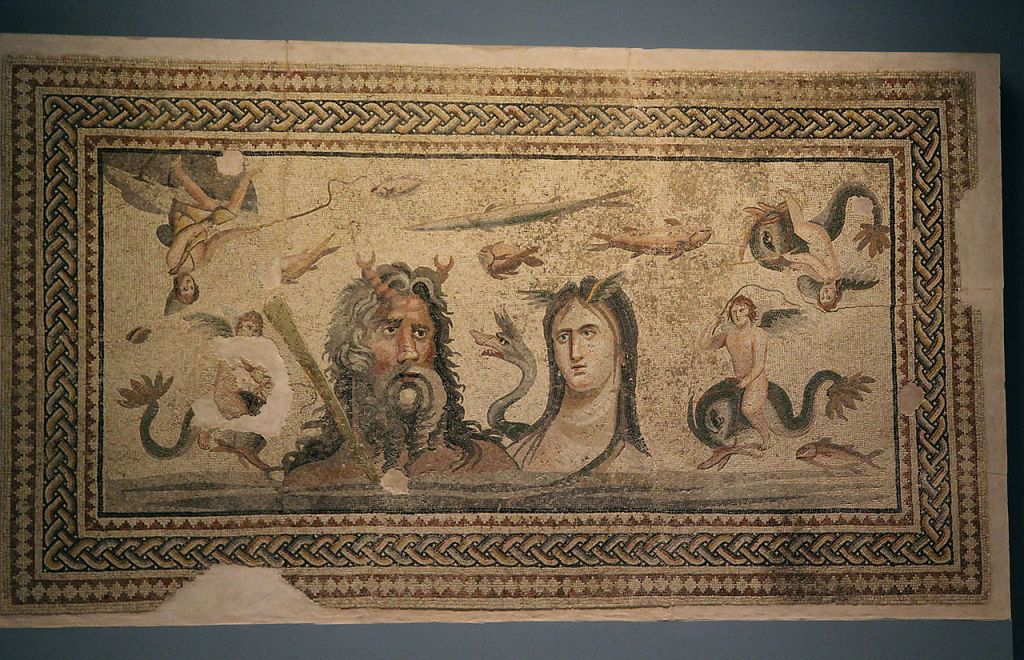
With the dawn of the Hellenistic era, exploration opened new horizons, both literally and figuratively. Oceanus, once the god of a mythical freshwater river encircling the world, underwent a transformation. He became associated with the vast, newly-discovered Atlantic and Indian Oceans, reflecting the expanding human understanding of the world’s geography. Mosaic art of the period depicted him not as a freshwater god, but as a powerful sea deity, often adorned with crab-claw horns, symbolizing his dominion over the saltwater realm.
Art


 Digital Maps of the Ancient World